How to build go-to-market from scratch
This is the second article in The Blueishprint series, where we break down the building blocks of a scalable go-to-market motion. In this piece, we walk through the full process, from foundation to expansion, and explain why the order matters.
By Friso Paping & Tim de Rooij · 13 April 2026
TL;DR
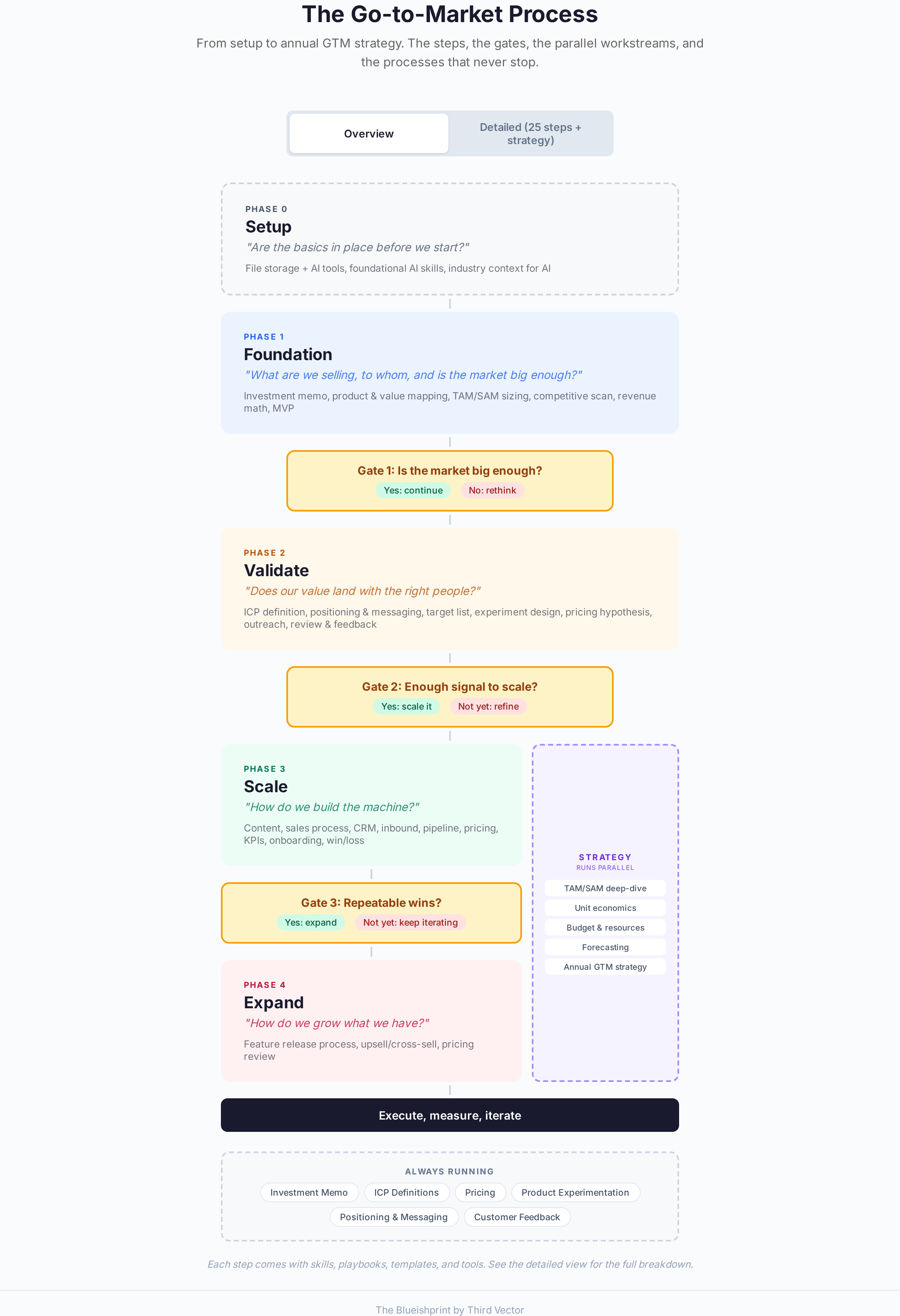
Building a go-to-market is not a single strategy document. It's a sequence of phases, each with a gate you need to pass before moving on.
- Phase 0 (Setup): Get your file storage, AI tools, and foundational skills configured before you do anything else.
- Phase 1 (Foundation): Write your investment memo, map the product value, size the market. If TAM/SAM doesn't hold up, go back.
- Phase 2 (Validate): Define your ICP, build a target list, run experiments. If the messaging doesn't land, refine and repeat.
- Phase 3 (Scale): Build the machine. Content, sales process, CRM, inbound, pipeline generation, pricing, KPIs, onboarding, win/loss analysis. Gate: repeatable wins and consistent pipeline velocity.
- Phase 4 (Expand): Grow what you have. Feature release process, upsell/cross-sell, pricing review.
- Strategy (parallel): Runs alongside Phase 3 and 4. Full TAM/SAM deep-dive, unit economics, budget planning, forecasting, annual GTM strategy.
Every step comes with deliverables: AI skills, guides, prompt-templates, and tools. And six processes never stop running: your investment memo, ICP definitions, product experimentation, pricing, positioning & messaging, and customer feedback.
The full process at a glance
We built an interactive flowchart that maps out the entire go-to-market process. All 25 steps, three gates, the strategy track, and the deliverables for each step. You can toggle between a high-level overview and the detailed version.
View the interactive GTM flowchart ↗
The rest of this article walks through each phase and explains why they're in this order.
Why order matters
Most go-to-market advice skips the sequencing. You get a list of things you should do, tactics that worked for someone else, a framework with four quadrants. What's missing is the order, and the gates that tell you whether you're ready for the next step.
We recommend a structured, gated go-to-market process that starts from first principles and scales to a full annual strategy. We split it into five phases, each with clear steps, and each ending with a checkpoint. If you pass the gate, you move on. If you don't, you go back and fix what's broken.
For every step in the process, we provide four types of deliverables. Skills are specialized instructions that teach AI models specific workflows, styles, or domain expertise, allowing them to perform complex, repetitive tasks efficiently. Guides are deep-dive articles with practical how-tos or frameworks for the team. Prompt-templates are structured prompts you configure with your own context and run tasks. And tools are software recommendations for the infrastructure you need.
Phase 0
Setup
Before you build anything, make sure your basics are in place. This sounds obvious, but we see teams jump into outreach or content creation with no shared file structure, no AI tooling configured, and no shared language around what they're building.
Three things to sort out first. Set up your shared file storage and connect the AI tools you'll use throughout the process. Configure your foundational AI skills (such as the humanizer, so your output doesn't read like a chatbot wrote it), tone of voice, formatting standards. And feed your AI the right context: industry keywords, jargon, a high-level description of what you're building. Context in, quality out.
This takes a day. Maybe two. But it saves you weeks of rework later.
Phase 1
Foundation
"What are we selling, to whom, and is the market big enough?"
You start with an investment memo. This is a founder exercise. You write down the value, the product, the target market in a short, crisp document. Think of it as an internal pitch, something anyone on the team can read and immediately understand what you're doing and why.
From there, you do product and value mapping. What do we aspire the product to be? What value do we expect it to deliver? This matters especially when you're not building a mass consumer product. In B2B, thinking explicitly about value delivery is the foundation of everything that follows, from positioning to pricing to how you structure your sales conversations.
Then you size the market. Back of the envelope only. You can kill yourself on TAM/SAM analysis, and many teams do. At this stage, you just need to know: is this market big enough to be worth pursuing? A quick top-down and bottom-up estimate. If the answer is no, you go back to step one and rethink your product or your target.
That's Gate 1. Pass it, and you continue.
After the gate, you do a quick competitive landscape scan. Who else is in this market? How do they position themselves? What problems do they claim to solve? This is not a detailed battle card exercise. That comes later. This is orientation.
Then revenue target math. You probably have an ARR or MRR goal. Work backwards. How many logos do you need? What deal size does that imply? What kind of sales motion can realistically support that volume? If you need to sign 200 enterprise clients in your first year without a sales team, that number is telling you something. Either your target is unrealistic, your pricing needs to change, or your go-to-market motion needs to be fundamentally different.
The phase ends with an MVP definition. What are we building? Who are we selling to? What are the minimum product requirements to test our assumptions?
Phase 2
Validate
"Does our value land with the right people?"
You start with ICP definition. Ideal Customer Profile. This is a team exercise, not a solo founder activity. Get everyone who touches customers into a room, customer support, implementation, tech, sales, and define what your ideal client looks like. Crucially, define it using data points you can actually measure externally. "Companies that care about innovation" is not an ICP. "B2B SaaS companies with 50–200 employees, Series A or later, with a customer support team of 10+" is.
ICP will evolve over the lifetime of your company. It's never fixed. But you need a starting point to test against.
Once you have your ICPs, you work on positioning and messaging. How do you speak to each type of ICP? What's the persona within those companies? What problems do they lose sleep over? This is where a lot of teams skip ahead to outreach without doing the positioning work first, and then wonder why their cold emails get ignored.
Next, build your initial target list. Combine your ICP definition with externally measurable data points to populate a list of companies. Then find the right individuals within those companies. If you're going after a consumer market, the company layer drops away. But for B2B, it's always two steps: which company, then which person.
Now you design experiments. You're going to run multiple outreach experiments in parallel, with short review cycles, testing different variables: messaging, channels, cadences, value propositions. Each experiment targets a specific ICP group. Minimum two, ideally four to six. The goal is to learn which combination of ICP, message, and channel actually converts.
Before you run those experiments, you need a pricing hypothesis. Prospects will ask about pricing early. If you don't have a ballpark, you'll get checked out of conversations fast. There are three approaches: cost-based, value-based, and competitive-based pricing. At this stage, you pick one direction and test it. The deep pricing work comes later.
Then you run aggressive outreach cadences, measure results, and collect feedback. What are the numbers telling you? What are prospects actually saying?
Gate 2: do you see emerging patterns? Do you understand how to reach your targets consistently? If yes, you move to scale. If not, you loop back to ICP definition and refine.
Phase 3
Scale
"How do we build the machine?"
Content comes first. Everything you learned in Phase 2, the messaging that worked, the objections you heard, the language your ICPs use, feeds directly into your content. A lot of content creation can be accelerated with AI now, but the quality of that content depends entirely on the quality of the input.
In parallel, you build three things: your sales process (how deals actually move through stages), your CRM and go-to-market infrastructure (the systems that capture everything), and your inbound engine (website, SEO, demos, content distribution). These three are interdependent and should be built together.
Once that infrastructure is in place, you systematize pipeline generation. Outbound and inbound, measured continuously. Pipeline measurement is where many teams start to feel real about their go-to-market. You're no longer guessing, you're watching deals move.
As deals progress through the pipeline, pricing becomes critical. This is where you move from hypothesis to real pricing work. Value-based, cost-based, or competitive, it doesn't matter which framework, what matters is that you approach it as a discipline, not an art. We have dedicated guides and templates for this.
Define your metrics and KPIs. When you set up your CRM and sales process, you already started thinking about what to measure. But once pipeline starts flowing, you need to know how to act on those metrics. What we see a lot is that pipelines are based on hope rather than data. Conversion rates, pipeline velocity, deal cycle times, these are the numbers that tell you whether your machine is actually working.
In a separate workstream, you think about onboarding and first value delivery. If this breaks, pipeline doesn't matter. How fast can you get customers live and delivering the value you promised? And you run win/loss analysis on every closed deal. Why did we win? Why did we lose? Link the answers back to your ICP definition.
Gate 3: repeatable wins and consistent pipeline velocity. Deals move through the pipeline at a predictable rate. Conversion rates are steady month over month. You can have different motions running side by side, different countries, different products, different segments. But each motion needs to be repeatable on its own.
Phase 4
Expand
"How do we grow what we have?"
Once you start onboarding customers, the cheapest revenue is sitting right in front of you. It's always easier to sell to an existing customer where you've already done the legal work and built the relationship.
This phase covers three things. First, your feature release process. How do new features reach existing clients? Think release cadence, product marketing for existing customers, and pricing implications of new functionality. Second, your upsell and cross-sell strategy. What triggers an expansion conversation? What upgrade paths exist? How does the commercial team identify and act on those signals? Third, a pricing review against actual usage data, expansion revenue, and competitive moves.
The strategy track
Strategy runs in parallel with Phase 3 and 4. It doesn't wait until you've built the machine. Once you have your foundation and your initial ICP validated, you should start planning ahead.
We always recommend planning at least a year out. It forces you to step back from the day-to-day. What do we want revenue to be? What can we invest to get there? How big does the team need to be, and what performance do they need to deliver? What's the average deal size we need to sign?
The strategy track includes a full TAM/SAM analysis overlaid against your actual pipeline penetration. Unit economics validation, are we reaching our goals cost-effectively? Budget and resource planning, including headcount, ramp time, and performance targets. And forecasting, which used to be more art than science but doesn't have to be. You can triangulate cohort analysis, conversion rates, bottom-up enterprise modeling, and velocity-adjusted weighted pipeline to build a forecast you can actually trust.
What never stops
Six processes run continuously from the moment they start:
- Your investment memo updates as you learn what works. It's your elevator pitch for investors, for new hires, for anyone who needs to understand what you sell and why. Keep it current.
- Your ICP definitions evolve as your product grows and your markets expand.
- Product experimentation continues to validate whether product value and ICP align, ideally measured live within the product.
- Pricing refines as you add functionality and close more deals.
- Positioning and messaging sharpens with every customer conversation.
- Customer feedback feeds back into everything: ICP definitions, product marketing, feature prioritization.
What's next
In future Blueishprint articles, we'll go deep on individual steps. Some will get their own article, others we'll combine. We'll share the skills, guides, prompt-templates, and tools for each step as we go.
Next up: the Investment Memo. How to write one, what it should contain, and why it's the single document everyone on your team should be able to recite.
The Blueishprint
Subscribe for the next article
The Blueishprint is published on Substack. Subscribe to get new articles as they come out.
Subscribe on Substack